
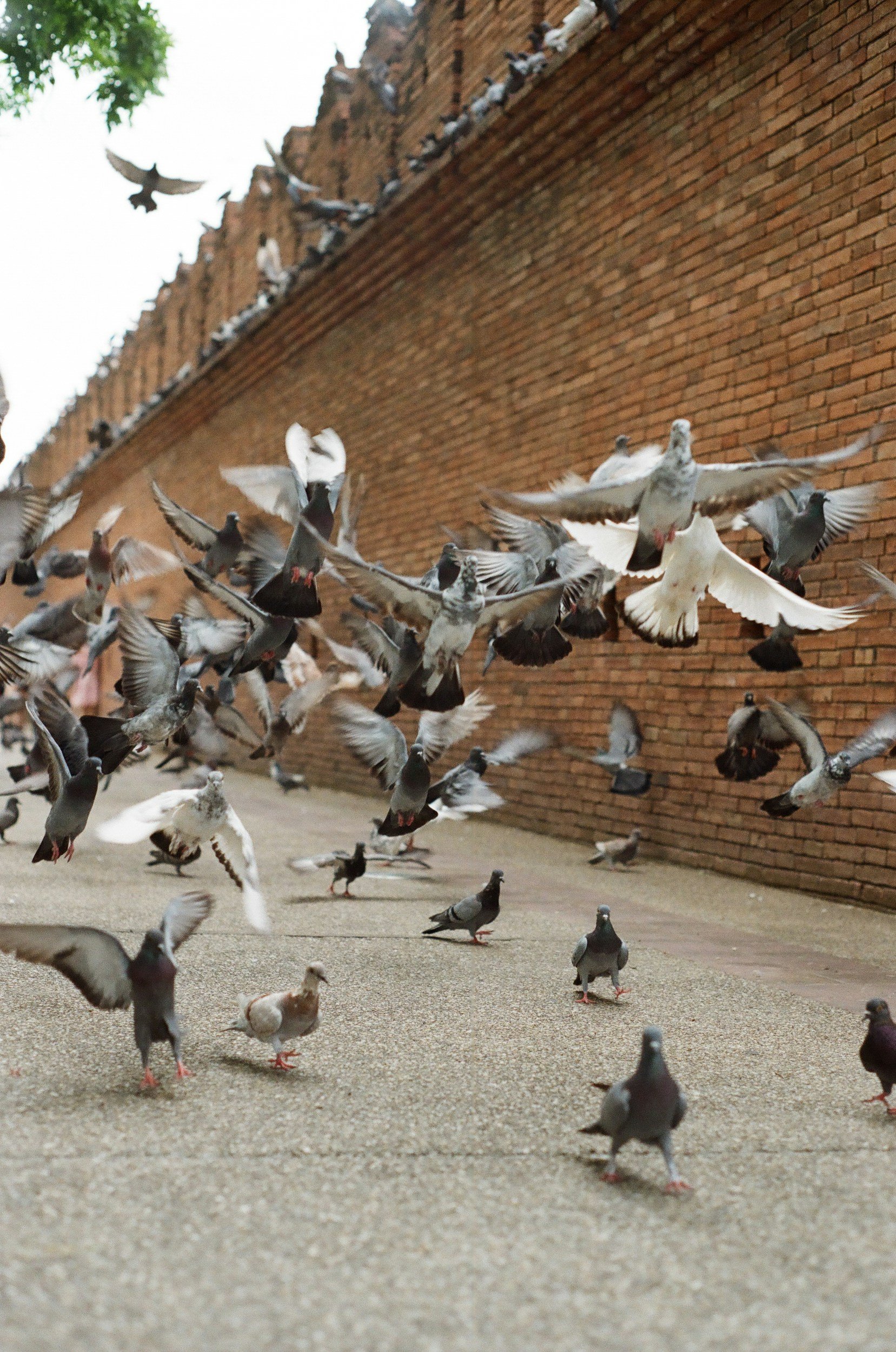
A May 2026 feature in The Telegraph titled "The city that put pigeons on the pill" put a global question on the UK's desk. Cities across Europe are moving away from killing pigeons and toward humane bird contraception, with Barcelona running more than 40 dispensers that quietly cut local pigeon numbers without traps, nets, or poisons. The UK is paying attention. But it has not moved.
OvoControl, manufactured by Innolytics, LLC, is the humane pigeon birth control product behind much of this shift. It is already registered and in active use in the United States, Canada, Australia, and the United Arab Emirates, protecting airports, food facilities, ports, power stations, and city centers from pigeon damage without harming the birds. The product uses nicarbazin, a compound safely fed to poultry for over 70 years, that affects only birds and has no impact on other animals.
In the Telegraph article, OvoControl CEO Erick Wolf confirmed that UK businesses have already reached out. A UK power station contacted him because bird droppings had become so severe that some work areas could not be used until they were cleaned. A UK port operator made a similar inquiry. The demand in the UK is real, and it is coming from exactly the kinds of facilities that most need humane, low-disruption pigeon control.
The need is acute, and it's coming from UK businesses, councils, and facility managers. So why can't they actually use it?
The Real Barrier Is Regulation and Classification
The problem is regulation. It comes down to two things, how the UK labels the product and how much that label costs to deal with.
In the UK, when nicarbazin is used to stop pigeons from breeding, it is not called a veterinary medicine (something that helps an animal's health). It is called a biocide (a chemical used for pest control). That difference is a big deal. The biocide path costs a lot more to go through.
Erick Wolf explained this clearly to The Telegraph: "Long story short, the use of nicarbazin as a means to contracept a pest bird is not considered a veterinary claim and instead a biocidal one. We have tried this route as well and have been rebuffed in the UK."
The second barrier is the cost of that biocide route. Wolf told The Telegraph that registering the product for use on pigeons in the UK would be "more than a small company" like his could handle. It is the fees, the testing, and the paperwork that the UK biocide system requires.
The approval would have to come through the Veterinary Medicines Directorate, described by The Telegraph as "a Defra quango, which protects animal health, public health and the environment."
Other European countries have already found ways around this. The Telegraph reports that nicarbazin "has been authorized in individual countries such as Italy and Belgium (as ACME product R-12) through an EU pharmaceutical route known as 'the National Procedure.'" In parts of Spain, it is permitted through a special-exception process called the "Procedure for Exceptional Prescription by Therapeutic Vacuum." The UK has not used any of these flexible paths.
A UK Pigeon Study Would Unlock the Market
In The Telegraph, Wolf himself pointed to the way forward. The paper writes that Wolf "suggested a pigeon-centered study, such as the research carried out on grey squirrels, may be the way forward." As he told the paper, "Little would prevent a manufacturer from basic testing there under the auspices of a reputable institute or university."
The grey squirrel comparison is not random. The same article notes that the UK government's own Animal and Plant Health Agency is already working with the UK Squirrel Accord, "developing an oral contraceptive vaccine for grey squirrels to give the native reds a chance to repopulate." The UK has already accepted that wildlife contraception works for one species. A similar study for pigeons would build the same evidence base for the regulator.
That evidence is what is missing. With it, British cities, ports, power stations, food facilities, and heritage sites could finally have a humane option, instead of harsher methods or none at all.
OvoControl is ready to support that work, exactly as Wolf described: a study by a credible UK university or institute that gives the UK its own pigeon data.
About OvoControl
OvoControl is a humane pigeon control program developed by Innolytics, LLC. Instead of trapping, netting, or poisoning, it uses birth control to gradually reduce pigeon populations. Over time, flocks decline by about 50% each year, dropping to roughly 5-10% of their starting levels.
The program is built for large outdoor sites and facilities where traditional methods are too costly or impractical. Today, OvoControl is used at refineries, power plants, food processing facilities, hospitals, universities, hotels, rail yards, prisons, steel mills, and city centers worldwide.
It is currently registered for use in the United States, Canada, Australia, the United Arab Emirates, Malaysia, and Chile. The product carries a Tier 3 pesticide classification under USGBC and San Francisco Department of the Environment guidelines, supporting LEED-aligned green building practices. The Humane Society of the United States recommends contraception for birds.
Learn more at www.ovocontrol.com.
